Which countries use VPNs the most?#
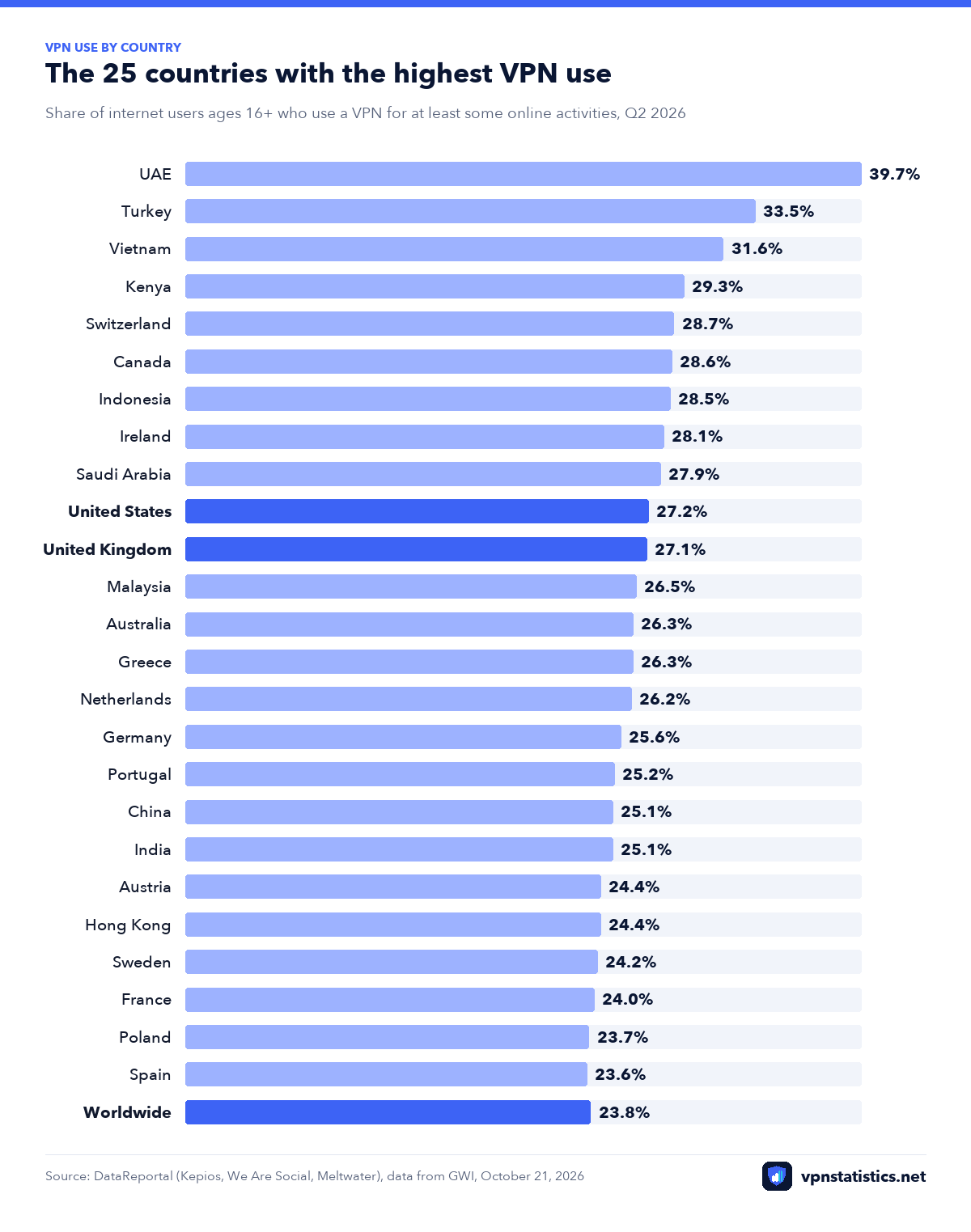
The United Arab Emirates has the highest rate of VPN use: 39.7% of internet users ages 16 and older use one for at least some online activities. Turkey (33.5%), Vietnam (31.6%), Kenya (29.3%) and Switzerland (28.7%) complete the top five.[1]
of internet users in the UAE use a VPN, the highest of 53 countries surveyed.[1]
of internet users in Ghana use a VPN, the lowest of the 53 countries.[1]
of internet users in the United States use a VPN, up from 25.4% a year earlier.[1]
of internet users in the United Kingdom use a VPN, up from 25.6% in Q2 2025.[1]
The 25 countries with the highest VPN use
Share of internet users ages 16+ who use a VPN for at least some online activities, Q2 2026
Source: DataReportal (Kepios, We Are Social, Meltwater), data from GWI, October 21, 2026[1]
Show data table
| Country | Share of internet users |
|---|---|
| UAE | 39.7% |
| Turkey | 33.5% |
| Vietnam | 31.6% |
| Kenya | 29.3% |
| Switzerland | 28.7% |
| Canada | 28.6% |
| Indonesia | 28.5% |
| Ireland | 28.1% |
| Saudi Arabia | 27.9% |
| United States | 27.2% |
| United Kingdom | 27.1% |
| Malaysia | 26.5% |
| Australia | 26.3% |
| Greece | 26.3% |
| Netherlands | 26.2% |
| Germany | 25.6% |
| Portugal | 25.2% |
| China | 25.1% |
| India | 25.1% |
| Austria | 24.4% |
| Hong Kong | 24.4% |
| Sweden | 24.2% |
| France | 24.0% |
| Poland | 23.7% |
| Spain | 23.6% |
| Worldwide | 23.8% |
VPN use in all 53 countries#
Sort by any column, or type a country name to filter. Change is in percentage points between the two survey waves.
Share of internet users ages 16+ who use a VPN, by country
| Country | Rank | Q2 2026 | Q2 2025 | Change (pts) |
|---|---|---|---|---|
| UAE | 1 | 39.7% | 38.9% | +0.8 |
| Turkey | 2 | 33.5% | 35.3% | -1.8 |
| Vietnam | 3 | 31.6% | 28.8% | +2.8 |
| Kenya | 4 | 29.3% | 24.1% | +5.2 |
| Switzerland | 5 | 28.7% | 27.2% | +1.5 |
| Canada | 6 | 28.6% | 28.0% | +0.6 |
| Indonesia | 7 | 28.5% | 31.4% | -2.9 |
| Ireland | 8 | 28.1% | 25.6% | +2.5 |
| Saudi Arabia | 9 | 27.9% | 27.8% | +0.1 |
| United States | 10 | 27.2% | 25.4% | +1.8 |
| United Kingdom | 11 | 27.1% | 25.6% | +1.5 |
| Malaysia | 12 | 26.5% | 27.8% | -1.3 |
| Australia | =13 | 26.3% | 26.2% | +0.1 |
| Greece | =13 | 26.3% | 19.0% | +7.3 |
| Netherlands | 15 | 26.2% | 26.3% | -0.1 |
| Germany | 16 | 25.6% | 24.2% | +1.4 |
| Portugal | 17 | 25.2% | 25.2% | +0.0 |
| China | =18 | 25.1% | 19.6% | +5.5 |
| India | =18 | 25.1% | 24.2% | +0.9 |
| Austria | =20 | 24.4% | 24.5% | -0.1 |
| Hong Kong | =20 | 24.4% | 23.5% | +0.9 |
| Sweden | 22 | 24.2% | 23.7% | +0.5 |
| France | 23 | 24.0% | 20.6% | +3.4 |
| Poland | 24 | 23.7% | 22.6% | +1.1 |
| Spain | 25 | 23.6% | 22.4% | +1.2 |
| Singapore | 26 | 23.5% | 25.9% | -2.4 |
| Philippines | 27 | 23.2% | 22.1% | +1.1 |
| Norway | 28 | 22.8% | 22.2% | +0.6 |
| Czechia | =29 | 22.3% | 22.1% | +0.2 |
| South Africa | =29 | 22.3% | 21.0% | +1.3 |
| Denmark | 31 | 21.9% | 21.5% | +0.4 |
| Belgium | =32 | 21.7% | 20.1% | +1.6 |
| New Zealand | =32 | 21.7% | 21.2% | +0.5 |
| Thailand | =32 | 21.7% | 18.7% | +3.0 |
| Egypt | 35 | 20.9% | 21.6% | -0.7 |
| Hungary | 36 | 20.7% | 17.8% | +2.9 |
| Taiwan | 37 | 20.3% | 16.6% | +3.7 |
| Romania | 38 | 19.9% | 18.4% | +1.5 |
| Croatia | 39 | 19.3% | 17.7% | +1.6 |
| Brazil | 40 | 19.2% | 18.8% | +0.4 |
| Italy | 41 | 19.1% | 18.2% | +0.9 |
| Chile | 42 | 18.5% | 16.9% | +1.6 |
| Colombia | 43 | 17.7% | 19.5% | -1.8 |
| Bulgaria | 44 | 17.6% | 16.5% | +1.1 |
| South Korea | 45 | 16.9% | 15.7% | +1.2 |
| Serbia | 46 | 16.3% | 16.7% | -0.4 |
| Mexico | 47 | 16.2% | 18.1% | -1.9 |
| Argentina | 48 | 15.7% | 14.2% | +1.5 |
| Nigeria | 49 | 14.1% | 24.1% | -10.0 |
| Israel | 50 | 14.0% | 13.6% | +0.4 |
| Japan | =51 | 9.5% | 9.9% | -0.4 |
| Morocco | =51 | 9.5% | 5.7% | +3.8 |
| Ghana | 53 | 7.3% | 12.1% | -4.8 |
Source: GWI via DataReportal, Digital 2027 (Q2 2026) and Digital 2026 (Q2 2025).[1][2] Worldwide: 23.8% in Q2 2026.
Biggest changes since 2025#
39 of the 53 countries moved by less than two percentage points between Q2 2025 and Q2 2026. 14 moved by two points or more:
- Greece: 19.0% → 26.3% (+7.3 points)
- China: 19.6% → 25.1% (+5.5 points)
- Kenya: 24.1% → 29.3% (+5.2 points)
- Morocco: 5.7% → 9.5% (+3.8 points)
- Taiwan: 16.6% → 20.3% (+3.7 points)
- France: 20.6% → 24.0% (+3.4 points)
- Thailand: 18.7% → 21.7% (+3.0 points)
- Hungary: 17.8% → 20.7% (+2.9 points)
- Vietnam: 28.8% → 31.6% (+2.8 points)
- Ireland: 25.6% → 28.1% (+2.5 points)
- Singapore: 25.9% → 23.5% (-2.4 points)
- Indonesia: 31.4% → 28.5% (-2.9 points)
- Ghana: 12.1% → 7.3% (-4.8 points)
- Nigeria: 24.1% → 14.1% (-10.0 points)
We think large single-wave swings (Nigeria’s 10-point fall, for example) may reflect changes in the online panel as much as real behavior, so we would not report them as trends without a second wave.
What about Russia and China?#
Russia had the highest rate of any country at 50.3% of internet users in Q2 2025, the latest Russian figure published in DataReportal’s annual report.[2] GWI stopped surveying Russia in the first quarter of 2026, so it is missing from the current table, and DataReportal recalculated the worldwide history without it.[1]
China shows 25.1%. GWI surveys online panel members, who in China are mainly urban and well connected, and only government-approved VPNs are legal there, so the figure is not a national rate.[3]
Downloads per person is a different measure#
You may see much higher figures, such as “85% of people in the UAE use a VPN.” Those come from Cybernews, which divides VPN app downloads by population. Downloads include reinstalls and leave out desktop users, so the result is not a share of people.[4]
Cybernews’s numbers are still useful for scale: the UK recorded about 18.3 million downloads of the top 50 VPN apps in 2025 (16.6 million in 2024), and the US about 54.1 million (63.4 million in 2024).[4]
About this data#
GWI, a market research company, asks internet users ages 16 and older whether they use a VPN “for at least some of their online activities.” It surveys online panels in 53 countries each quarter. DataReportal publishes the figures in its annual Digital reports.[1]
GWI changed its age range in 2024 (adding people ages 65 and older), and older reports used a “past month” question for ages 16 to 64. That is why 2019 figures, such as Indonesia at 61%, can’t be compared with today’s.[5]
Questions about VPN use by country#
Which country uses VPNs the most?
Which country uses VPNs the least?
What percentage of people in the US use a VPN?
Why isn’t Russia in the 2026 ranking?
Sources
Numbered sources match the superscripts on this page. We link to the original publisher wherever one exists. How we check figures · Report an error
- DataReportal (Kepios, We Are Social, Meltwater), data from GWI. Digital 2027 Global Overview Report, VPN slides 334–336, October 21, 2026. GWI survey of internet users ages 16+, Q2 2026. Russia removed from all historical values.
- DataReportal (Kepios, We Are Social, Meltwater), data from GWI. Digital 2026 Global Overview Report, VPN slides 250–252, October 15, 2025. GWI, Q2 2025, Russia included.
- China Law Translate. MIIT notice on cleaning up and regulating the internet access service market, January 2017.
- Cybernews research team. VPN usage by country (app downloads), April 2026. Top-50 VPN apps on Google Play and the App Store, 126 countries; downloads, not users. The Cybernews page blocked our access, so figures were read via a syndicated summary (Digital Information World, April 13, 2026).
- Top10VPN and GlobalWebIndex. Global VPN Usage Report 2020 (PDF), March 2020. Base: 142,017 internet users ages 16–64, Q4 2019.